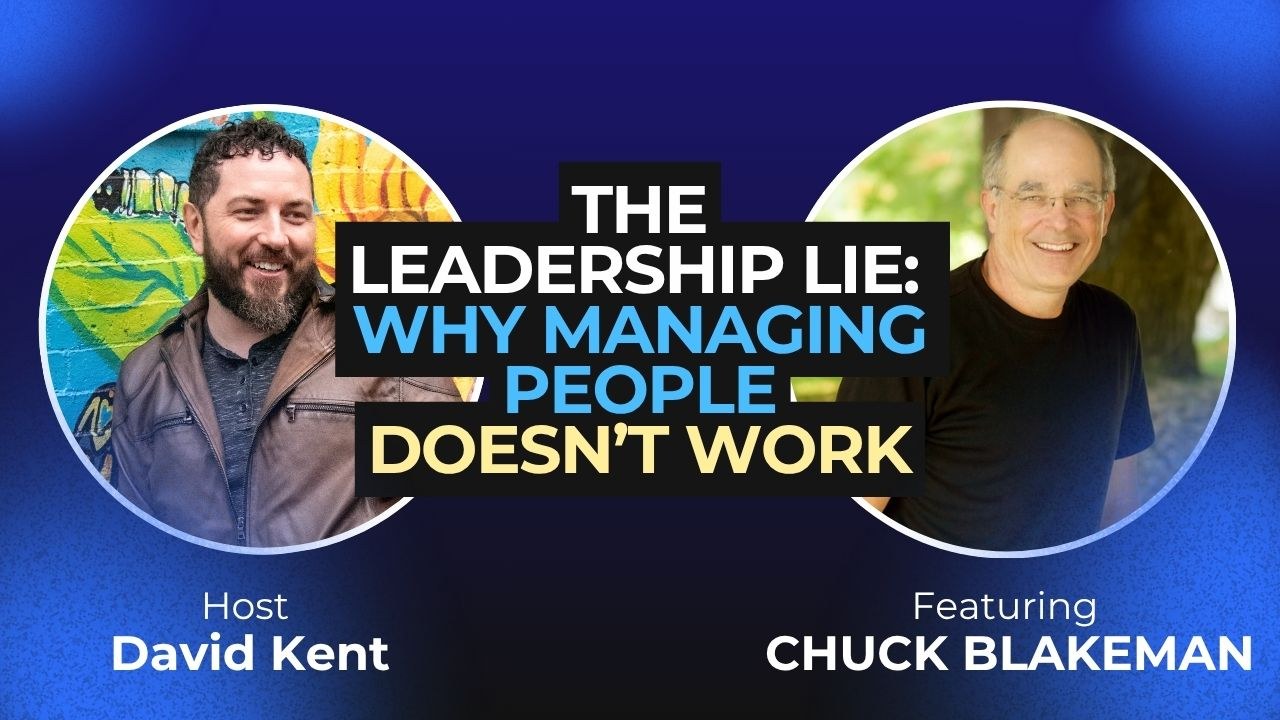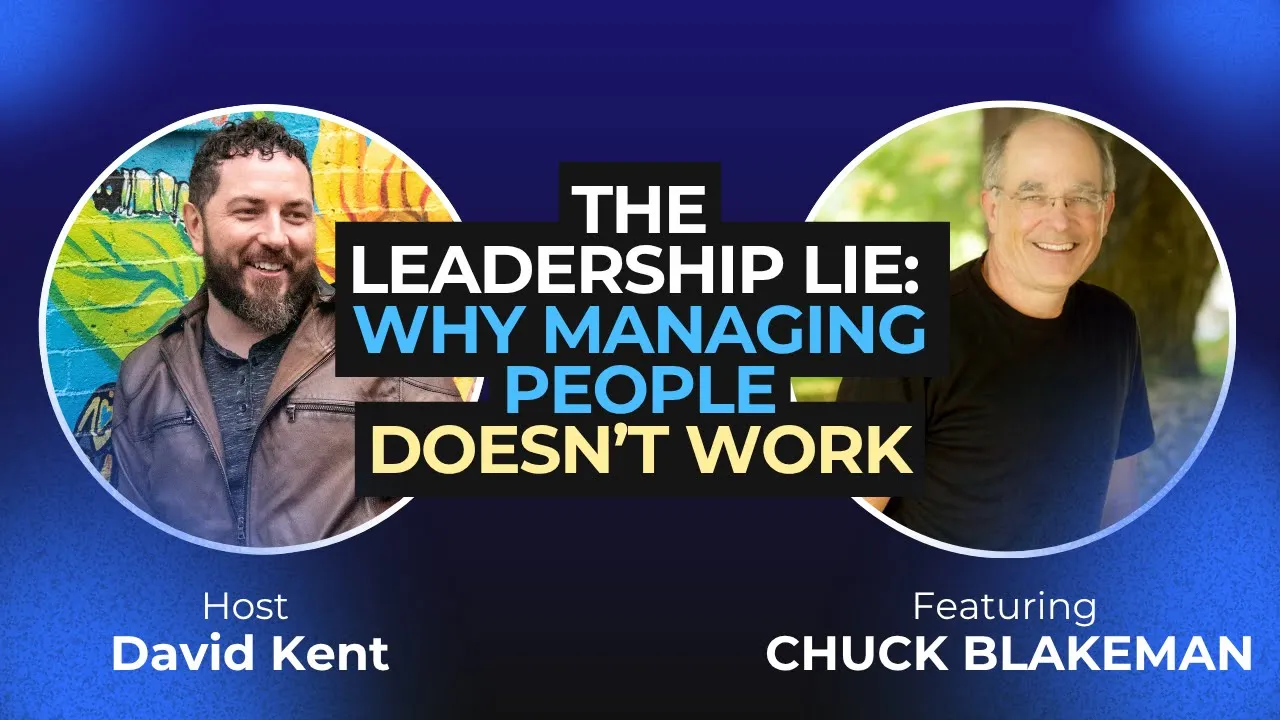
Most leadership debates are variations on the same theme: How do we manage people better? Chuck Blakeman walked onto the Lead Smarter Podcast and politely (well.. not that politely) let me know where he stands.
His argument, sharpened over 13 businesses across four continents and a stack of books I'm still working through, goes like this - Leadership and management have nothing in common. No overlap. No Venn diagram with a fat middle. Nothing. And the fact that we keep smashing the two together is one of the main reasons modern teams feel slow, political, and quietly resentful.
While I don't know Chuck's entire worldview, the idea he left myself and listeners with on divorcing leadership from management is worth sitting with. Most of our management habits are leftovers from a factory system that stopped making sense decades ago. If you're a founder or operator trying to figure out why scaling keeps making everything feel worse, it might be worth pulling on that thread a little.
But let me take a step back and give you a bit of a breakdown on the juicy bits of the conversation that stuck with me, and what I think effective leadership really looks like through Chuck's lens.
Manage stuff. Lead people.
Chuck's line, "manage stuff, lead people," is the cleanest articulation of this idea I've heard.
His framing: stuff is stupid and lazy. Your laptop doesn't want to do anything. Your processes don't care. Trucks, inventory, software, timelines, all of it needs managing, because none of it has a brain. Fine. Manage it.
People are different. They're smart. They have context. They want to contribute. Managing them the way you'd manage a supply chain is the fastest way to get them to act like inventory: waiting, idling, doing only what they're told.
The problem is that most organizations conflate the two. We hire someone with the title "manager of people," then act surprised when they spend their day approving timesheets instead of developing talent. We've designed jobs that require the same person to be a detail-obsessed process nerd and a deeply empathetic coach. Chuck's point, which I agree with, is that nobody can do all eight of those things well. So managers end up getting hated for the two or three things they're bad at, no matter who you put in the seat.
It's the most unfair job in the building. And we keep filling it.
The factory is still running. It's just wearing a hoodie.
One of Chuck's sharpest observations is that the industrial-age factory system is alive and well inside companies that think they're modern. He told a story about consulting with Google and being gobsmacked at how top-down, political, and hierarchical it was. His words: "the guys in ties making decisions for everybody else." He didn't last long there.
The assumptions baked into traditional management:
The people closest to the work can't be trusted to decide.
Efficiency comes from standardization and control.
Information flows up for approval. Instructions flow down.
That model fit when most work was repetitive and physical. It doesn't fit knowledge work. It doesn't fit remote work. It doesn't fit a team of thoughtful adults who usually know more about the customer than the person three layers above them.
And yet, open up the org chart of almost any tech company and you'll see the same pyramid Hammurabi would have recognized. Chuck pointed out that the word "manager" first shows up in Hammurabi's code, 5,000 years ago, in reference to slaves. That's not a rhetorical flourish. If you assume your people are "stupid and lazy," which are Frederick Winslow Taylor's actual words in his 1911 paper Scientific Management, a paper that still quietly shapes how we structure work, then yes, you need someone standing over them with a whip. Drop that assumption, and the whole apparatus starts to look pretty silly.
"But managerless can't possibly scale"
This is where I pushed back in our conversation, because it's where most leaders push back.
I can imagine self-management working on a team of eight. I run a small team at Unbottleneck, and most of my job is removing obstacles and getting out of the way. Scale that to 50,000 people? In a factory? Making jet engines?
Chuck was ready for me.
GE Aviation runs eight engine factories with no managers. These engines end up on about a third of the world's large aircrafts. You've probably flown in one.
Morning Star, a California tomato paste company, has operated without managers for roughly 40 years and is one of the largest producers in the world.
Haier, the largest white goods manufacturer on the planet, with 90,000 full-time people and 80,000 part-time, based in a country famous for bureaucracy, ripped out its management layer about 15 years ago. The company has since grown.
At Haier, every team is a profit center. Even the accounting team has to earn its work from internal customers. Don't like your accountant? Go find another one, internally. It sounds chaotic on the page. In practice, it's apparently one of the most disciplined operating models in the world.
You don't have to buy the full managerless vision to take the point. The objection "it can't scale" isn't true. We just don't like change. Chuck made the wry observation that the pneumatic hammer was invented in 1890 and nobody used it until 1990. Then COVID happened, remote work proved itself in roughly eight weeks, and the moment leaders had an excuse to drag everyone back into the office, most of them did. Despite the data. We don't need evidence. We need comfort.
This stood out to me as something deeper than just a lesson on leadership. This was a deeper nugget of truth Chuck had just surfaced about the human psyche in general, and is worth letting it sink in.
Managers tell. Leaders ask.
If you only take one thing from this post, let it be this one.
Managers tell. Leaders ask.
Managers walk in with the process, the answer, and the instructions. Leaders walk in with questions. What do you think we should do? What result are we trying to create? What do you need from me?
This sounds soft. It isn't. It's actually harder, because it requires you to trust that your team is capable, and to build the muscles of accountability without reaching for surveillance. Line-of-sight management says: I can see you, therefore you must be working. Leadership says: I trust you, and we've agreed on the outcome. Two very different operating systems.
When leaders default to telling, they train their people to wait to be told. That dependency then "justifies" another layer of management to handle all the waiting. It's a loop, and it's expensive. Chuck cited a study suggesting that around 15 of the top 20 reasons people quit their jobs are directly tied to their manager. Remove the manager, and you remove three-quarters of your attrition risk before breakfast.
I'm not suggesting every company fire its entire management layer tomorrow. I am suggesting every leader ask one question: in the last week, how many times did I tell when I could have asked?
Input equals ownership
This was one of Chuck's principles that I have already stolen and used before I sat down to write this very blog you're reading.
Input equals ownership. If people have no say in what the result should be, or how the process to get there is designed, they won't own the outcome. They'll execute it, at best. They'll mock it, at worst. The Dilbert Society, to use Chuck's phrase, where teams dutifully carry out whatever the manager dreamed up, knowing full well it won't work, and waiting for the inevitable collapse so they can feel vindicated.
The practical move is simple. Bring the team into the conversation about what "good" looks like before you design how to get there. Set the strategic frame as the leader, then let the people doing the work build the process. They're better at it than you are. Or, at least, they will be as long as you've hired well and given them the time and autonomy the need to succeed.
This isn't egalitarian fluff. It's operational. A process designed by the people who run it is a process that actually gets run. A process handed down from above is a process that gets worked around.
What I'm taking from this
While I am unlikely to take Chuck's message and go FULL anarchist and start storming organizations that still run on older manager models - I DO have a sharper set of questions I'd push any founder or operator to consider:
Where am I accidentally teaching my team to wait for permission?
Which decisions am I holding onto out of habit?
If my team couldn't reach me for a week, what would actually break, and is that a people problem or a systems problem?
Am I managing stuff, or am I managing humans like they're stuff?
The shift doesn't have to be dramatic. Ask one more question before you give an answer. Let a team own a decision end-to-end. Simplify one process so it focuses on the outcome instead of the steps. These compound. Not in a quarter. But in a year, they change how the whole place feels.
Chuck's framing is sharper than mine, and I'm sure that is for good reasons that are rooted in having deeper experience. I'm prone to soften a few edges. But the core move is one I'll die on the same hill for: treat people like adults, manage systems instead of humans, lead with questions.
If this resonates, the full episode with Chuck on the Lead Smarter Podcast goes deeper into the mechanics of distributed decision-making, the data behind managerless organizations, and why his new book Sell Less, Earn More argues the sales playbook is just as broken as the management one. Worth a listen.
And if you're wrestling with any of these questions in your own company, whether it's the line-of-sight reflex, the management tax, or scaling without layering, that's exactly the kind of work we help clients with at Unbottleneck. Book a conversation if you want to think it through together.

Sponsors This Podcast