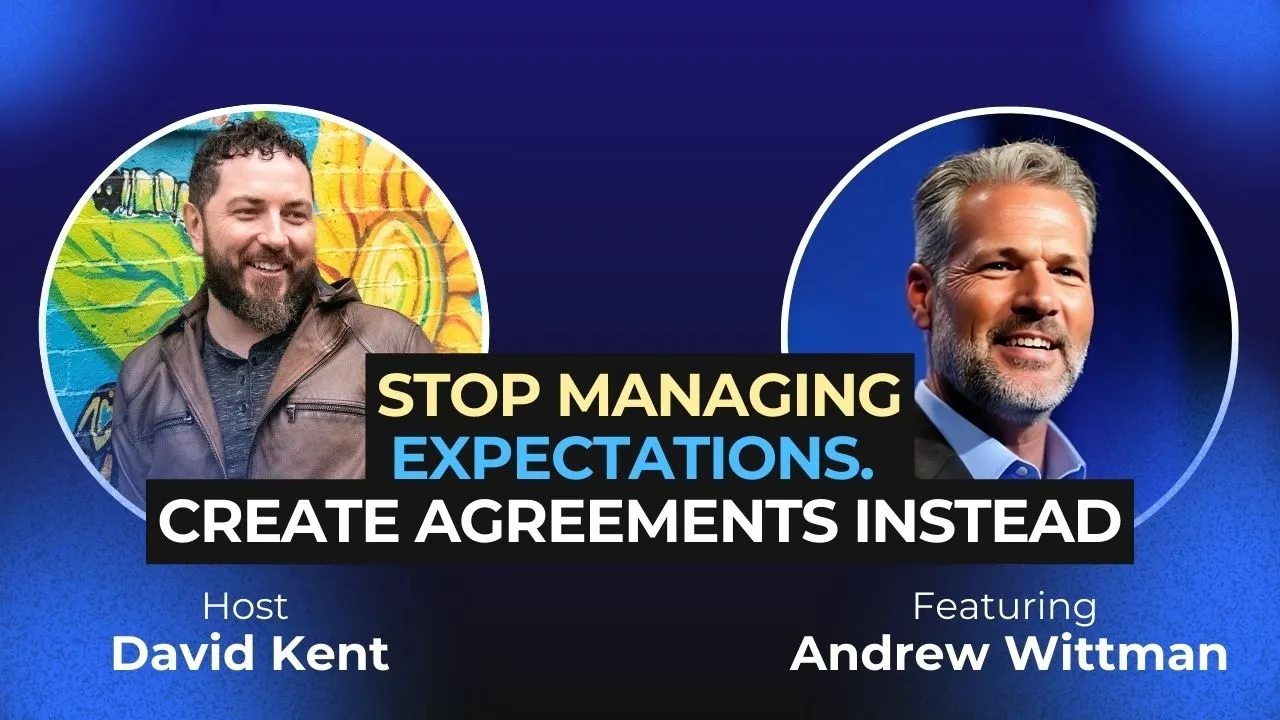
The email arrives on a Friday afternoon. A client you counted on is leaving. Or a key hire just resigned, or the launch slipped again. Pick your version. Before you have consciously decided anything, your body has already responded. Andrew Wittman calls this the hormone dump. Stress chemicals flood in, your thinking narrows, and the response that comes out of you is whichever one you have practiced the most.
That last part is the problem. Most leaders have never practiced a response at all, so the flood picks one for them. It usually picks frustration, blame, or dread, because those are the responses that got the most reps over the years.
Andrew has spent his career on this exact moment. He is a Marine Corps infantry combat veteran who now runs the Mental Toughness Training Center, and he joined me on Lead Smarter to talk about what resilient leadership requires. Two ideas from that conversation deserve a full walkthrough: his pairing of Inner Armor and Perpetual Resilience, and the identity work he says has to happen before you lead anyone else.
The Question That Trains the Armor
Andrew's move when bad news hits sounds almost absurd the first time you hear it. Get happy. His words. Bad news happens, get happy. Then ask yourself one question. How can I use this to my greatest possible advantage?
Here is why that works: the mechanics matter more than the slogan. Your brain answers whatever question you hand it. Hand it "why does this always happen to me" and it will dutifully go find evidence that you are cursed. Hand it the advantage question and it starts sifting through the situation for options. Andrew's claim is that the brain will find something even when the situation is genuinely bad. If every available idea is a bad idea, it surfaces the best bad idea. You get movement where you would otherwise get spiraling.
And Andrew sets the ambition higher than you'd expect. When I raised the obvious comparison, making lemonade from lemons, he waved it off. His version is deciding lemons are the new ice cream. Full on commitment to the reframing. You lean in, treat the setback as the main event of the day, and build on it as though it were the thing you had been waiting for.
This is where his two named concepts come in. Inner Armor is your trained default under stress, the response that fires when the hormone dump narrows your thinking. Perpetual Resilience is the maintenance plan behind it, the recognition that the armor rusts without daily reps.
The reps are the part most leaders skip, so let me make them concrete. Self-talk is already a routine. "I knew this was going to happen." "Here comes the other shoe." "The economy is going to sink us." Those lines have been rehearsed for years, and they fire right on schedule. Retraining the routine happens on small annoyances, well below crisis level. A candidate ghosts your final interview. The old routine says good people are impossible to find. The advantage question, asked honestly, might notice your interview process just got a free stress test. A meeting falls through, and the question finds you the open time you had been begging the calendar for all week. None of these answers changes your life. Every one of them is a rep, and the reps are what make the question available to you on the day a real crisis lands. Because if the first time you ask it is during a genuine emergency, the old routine will beat it to the punch. It has years of practice, and the new routine is just warming up.
Mastering Identity Before Leading Others
Before you can challenge yourself to “get happy” and ask “How can I use this to my greatest possible advantage”, there’s a prerequisite. The question only genuinely gets asked by someone who already believes they are the kind of person who asks it. So the real work sits underneath the technique, at the level of identity.
Andrew's helped confirm this by sharing his own story. He arrived at Marine Corps boot camp as an overweight kid who hated running, and boot camp is mostly running. So he started talking to himself mid-run. I am an ultra marathoner. I am an elite athlete. Running is my friend. None of it was true yet. He said it anyway, in the present tense, as though it already were. He calls it a faith statement. You claim realestate in your mind of an identity even before you achieve it, and then you go do what someone with that identity would do. An ultra marathoner runs today, so he ran today. The evidence accumulated mile by mile until his body caught up with the story, and the story became the fact.
The same structure runs through how he handles his health. I am a healthy person, so I do what healthy people do. He trains daily, and he reserves sick days for the rare occasions his body genuinely wins the argument. He pointed me toward a book called The Expectation Effect, which digs into how what you anticipate shapes what unfolds.
Now connect this to leading a team, because there’s a direct link. Your people study you constantly. What they are learning is whether Monday-morning you and “crisis you” are the same person. When your identity is settled, when you have decided in advance who you are under pressure, your moods lose their grip on your decisions, and your team gets a steady person to orient around. Skip that work and you lead from whatever hormone dump arrived that morning. Your team experiences that as unpredictability, and unpredictability erodes trust faster than almost any single bad decision, because people can forgive a wrong call far more easily than they can plan around a leader they cannot read.
I have already run this experiment in my own life, on a small scale. I train with a partner, and for a long stretch we showed up, went through the motions, and called it consistency. Then we picked a competition and gave ourselves a season to prepare for it. That decision changed who we were in the gym. We trained like competitors because we had decided we were competitors, and serious results followed. I will admit I still have to talk myself into loving certain workouts before they start. I know how the conversation ends, I love what they do for me, and the identity statement is what gets me through the front door.
The condition on all of this is behavior. An identity statement works as long as you pair it with the daily actions that person would take, and it keeps working only for as long as the actions continue.
The Thread That Ties It Together
People become the story they rehearse. The rehearsal runs whether or not you supervise it, in the language you use about yourself on ordinary days, and the person who shows up under pressure is the person that rehearsal built. Seen that way, the advantage question and the faith statement are the same move. Each one is a line of dialogue that belongs to the person you have decided to become, spoken out loud before the evidence arrives.
A Short Pressure Audit
Before your next hard week, write down answers to these four questions:
What is the first sentence you say to yourself when bad news shows up?
Who are you when things go sideways? Write it in one sentence, present tense.
What does your self-talk rehearse on an ordinary Tuesday, when nobody is correcting it?
What daily rep would prove the identity you just wrote down?
Keep the answers somewhere visible. The whole point is to install the routine in calm weather, well before you need it.
I run a version of Andrew's playbook adapted to my own operating cadence, and it has held up through the messier weeks of building two companies. The leaders who hold a team steady through chaos did the internal work first. Building that steadiness into a team, the onboarding, the agreements, the structure around every new hire, that's exactly the kind of work we help clients with at Unbottleneck. If you're scaling and want your next hire to land inside a system built for pressure, book a call with me and we'll talk it through.
The full conversation with Andrew is live now at https://share.transistor.fm/s/18f09381

Sponsors This Podcast