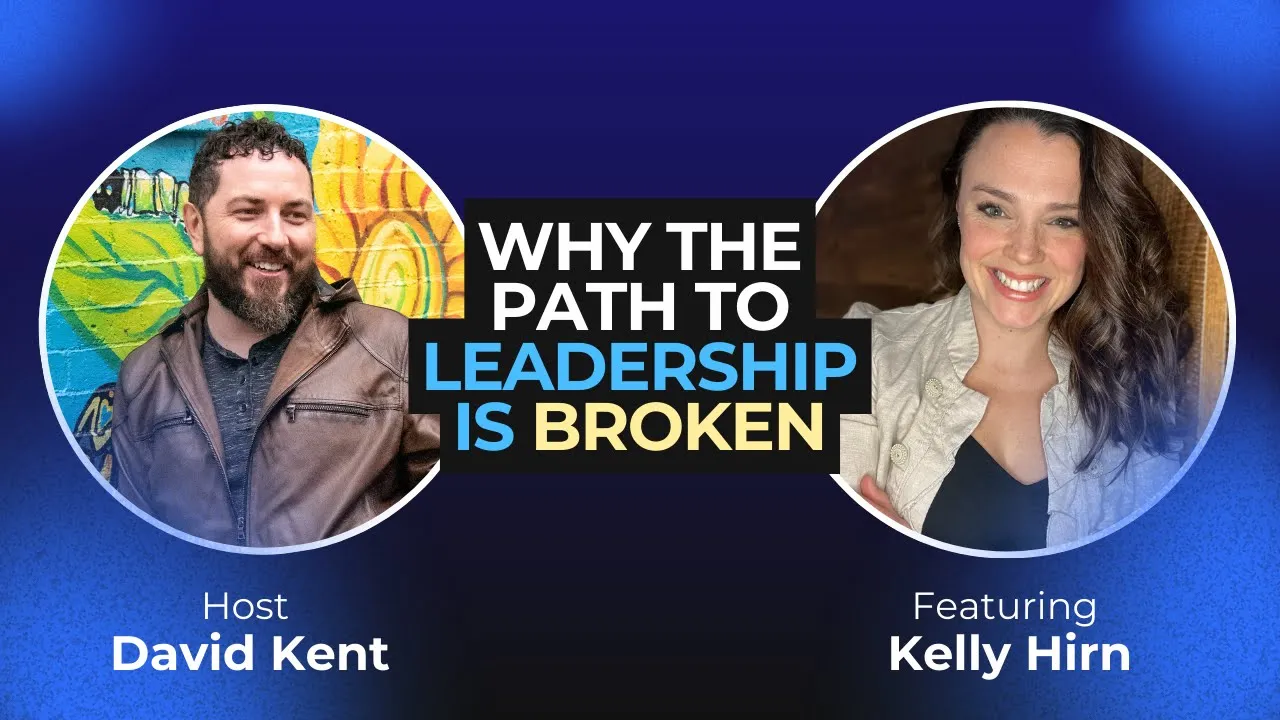
Ask a room of founders which role in their company does the hardest leadership work, and most will point to themselves. Kelly Hirn would point somewhere else. She would point to the middle.
Middle managers lead in every direction at once, and in most growing companies, they do it with less support than anyone above or below them. That tension sat at the center of my conversation with Kelly, Founder of Kelly Hirn's Transitional Leadership. We ranged across vision, imposter syndrome, curiosity, and leadership paths that never follow the ladder the org chart promised. The middle management thread earned its own post.
Kelly called this role one of the most critical pieces to a company's success, and she did it without a hint of the corporate flattery that usually surrounds that statement. She has lived it. She has coached through it. And the picture she painted of what this layer carries, and how often it gets squeezed from every direction, matches what I see inside growing companies every week.
The layer with a foot in both camps
Here is how Kelly laid out the structure. Supervisors manage the day-to-day and keep their hands close to the work, and executives cast the vision and generate the ideas. The middle manager sits between them with a foot in both camps, expected to see where everything is going and translate that into doing for the people closest to the work.
That translation job is leadership in every direction at once. A middle manager leads down to their team, up to executives who control direction and resources, and sideways to peers running functions they depend on. Most leadership content is written for the person at the top of the pyramid. Almost none of it acknowledges that the person in the middle is running a harder version of the same game with less authority to play it.
Kelly's view is that when this layer is supported and equipped, it becomes a genuine engine of change for the whole organization. That holds as long as three conditions are true. Middle managers need:
Real clarity on the vision, stated plainly enough to repeat
Actual decision authority within their scope, without everything routing back up for approval
A leader above them willing to clear obstacles instead of becoming one
Remove any one of those and the engine stalls. The strategy still gets announced but it just stops being translated.
Leading a team whose work you cannot do
Kelly's experienced this during her time in corporate leadership. She was promoted into a role leading teams whose work she had never done; reporting to her were people with decades more experience than she had. She calls that good fortune. Micromanagement was off the table because she had no basis for claiming she knew best, so what remained was curiosity or assumptions.
Kelly pointed out that you do not need to be forced into humility by circumstance the way she was. Anyone can choose to lead from curiosity before assumption. Your assumptions might even be partially right, especially if you built the business or did the role yourself. There is still no reason to start there.
I have seen the same dynamic inside my own companies. My team members are excellent at things I do not know how to do, and pretending otherwise would only slow them down and put me in the way. My default is to put the question in front of the team before I put my own answer on the table, because someone closer to the work usually sees an angle I cannot.
When the person above you becomes the wall
The uncomfortable part of Kelly's story is what happened next. Her results were strong and her approach was unconventional, and her boss responded by shutting her out of decision-making entirely. Kelly's word for it was a wall.
Kelly decided to stop spending energy on trying to break the wall and redirected that energy sideways, adding value to other departments through small working examples of a better way. Those departments started pulling her onto bigger and bigger projects without asking her manager's permission.
She summed up this principle with the reality that you have more power and control than you ever give yourself credit for. You just have to get curious with yourself to figure out how to make it work.
Most of us, when blocked, pour our energy into the blockage; the person, the policy, the unfairness of it. The instinct to fight the wall is strong, and it is rarely the highest-value use of what you have. Kelly's move was to treat her own energy as the scarce resource and route it toward the places it could compound.
Influence travels sideways too
Kelly gave a second example of the same principle at a bigger company. A project manager she was coaching kept getting dismissed by a room of senior leaders, so she built small proof points that her approach produced better results and found ONE ally among those leaders who saw the value. That ally knew title carried the weight in that room, so he helped her secure a promotion that gave her the standing for the group to take her ideas seriously. Soon after, the room started listening.
Some people will read that story and see politics. I read it as translation. Kelly's client did not compromise her ideas. She learned what the audience valued and delivered the message in a currency they could receive. Leading up and sideways is still leadership. The tenor changes but the work does not.
What founders and executives owe this layer
If you sit above middle managers, everything in this conversation lands on your desk. Kelly was direct about it. These are often the people doing some of the hardest leadership work in the organization, and they are rarely the first to get real support.
The support they need is specific:
Check-ins that address their leadership load, where they feel caught between conflicting expectations, and what is blocking them, alongside the usual review of metrics
Vision communicated clearly and repeated often enough that they can pass it downward without distortion
Decision-making pushed as far toward the front line as it can responsibly go, so they can act inside their scope without a permission loop
A genuine audit of whether YOU are the wall in someone's story
A middle management health check
Before you close this tab, run yourself through these questions. Answer honestly, and note the ones where you hesitate.
Could each of your middle managers state your company's vision in one sentence, out loud, without checking a document?
When did you last ask a middle manager where they feel most caught between conflicting expectations?
Can your middle managers make decisions about their own team's work, or does everything meaningful route back up to you?
When a middle manager gets strong results in a way you would not have chosen, do you study the method or correct it?
Do your check-ins with this layer cover their leadership load, or only their output?
Who in your company would tell you if a middle manager was hitting a wall above them? Would anyone?
If your best middle manager left tomorrow, how much of the translation between strategy and daily work walks out the door with them?
Every hesitation on that list is a conversation worth scheduling this week. Not a process overhaul. A conversation. Start there and let the process follow what you learn.
Where this connects to leading smarter
Middle management is where strategy either becomes daily work or becomes a slide nobody remembers. Supporting that layer means clear vision, real authority, curiosity as an operating habit, and leaders above them who clear paths instead of building walls.
If you are building out that layer right now, stepping into it yourself, or realizing your company's growth has outpaced the structure holding it together, that is exactly the kind of work we help clients with at Unbottleneck. Getting the right people into the right roles is half the battle. Building the leadership habits and support structure around them is where the leverage shows up.
You can book a conversation with me here: https://cal.com/david-kent/meeting-with-david-kent-unbottleneck
And if this post raised questions about your own middle layer, the full conversation with Kelly Hirn goes deeper on all of it: https://leadsmarter.transistor.fm/episodes/why-the-path-to-leadership-is-broken

Sponsors This Podcast